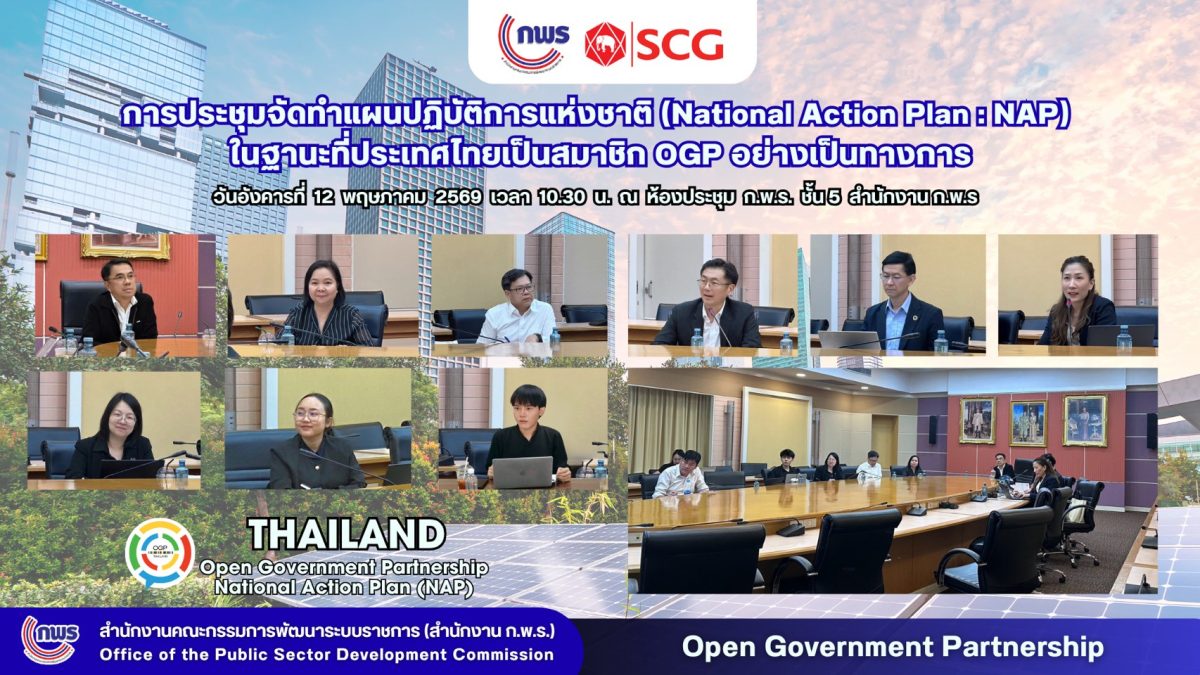
May 12, 2026 — Mr. Buntoon Srethasirote, Chair of the Subcommittee on Promoting Open Government and Public Participation, together with the OPDC team, held a consultation meeting with representatives from Siam Cement Group (SCG), led by Mr. Wachirachai Koonamwattana, Head of Smart System Solution Business; Mr. Tossaporn Supomai, Industry 4.0 Director; and Dr. Patima Sindhupinyyo, Associate Director of Sustainable Development/ESG Integration, to exchange views and strategies on advancing the Saraburi Low Carbon and Resilience City Project, which covers climate and environment policy areas, for co-creation the National Action Plan (NAP) under the Open Government Partnership (OGP) framework at the OPDC Meeting Room. Key discussion points are as follows:
1️⃣ Saraburi Sandbox Initiative toward a Low Carbon City is anchored on the PPPP (Public-Private-People Partnership) model, which integrates collaborative efforts among the public sector (policy and budget), the private sector (technology and innovation), and civil society (community participation) to achieve sustainable outcomes across the economic, social, and environmental dimensions.
2️⃣ Five-Pillar Implementation Strategy (5 Pillars)
❇️ Energy Transition: Focus on Smart Grid and Microgrid implementation, including unlocking Third Party Access regulations to enable fair-priced clean electricity trading. The ESCO (Energy Service Company) system will be employed for budget management in energy efficiency improvements.
❇️ Green Industry: Promoting the use of Low Carbon Cement (Hydraulic Cement) in the construction supply chain and seeking international cooperation to implement carbon capture technology.
❇️ Waste-to-Value Management: Employing a Regenerative Model to convert waste into resources, such as producing RDF (Refuse Derived Fuel) to replace coal in cement factories and systematically sorting plastic and organic waste to generate community income.
❇️ Low-Carbon Agriculture: Expanding wet-and-dry rice cultivation methods to reduce methane emissions and enhance production efficiency through biochar application.
❇️ Increasing Green Spaces: Developing sustainable community forests in Saraburi to prepare for carbon credit initiatives.
3️⃣ Case Study of International PPPP Models: SCG highlighted the Mexico Regenerative Industrial System model, a collaboration between Cemex and the Mexican government in developing a low-carbon city in Mexico City through a public-private joint investment project.
4️⃣ Additional Discussion Points
❇️ The meeting emphasized the importance of demonstrating concrete benefits to citizens (such as income from waste sales or returns from forest management) to create sustainable incentives and participation.
❇️ Collaboration with diverse partners including SCG, PTT, Krungthai Bank, and the World Bank to test systems and various legal requirements in this Sandbox area.
❇️ Projects included in the NAP should be promoted as practical Real Sandboxes with regulatory exemptions or relaxations to enable on-ground implementation.
❇️ Support for Saraburi Province as a pilot area to test Floating Solar technology as a case study for energy-sector Sandbox initiatives.
📌 Next Steps: The OPDC will consult with Saraburi Province, the private sector, and civil society in June 2026 to jointly design the NAP.