National Action Plan Creation
1. Action Plan Development
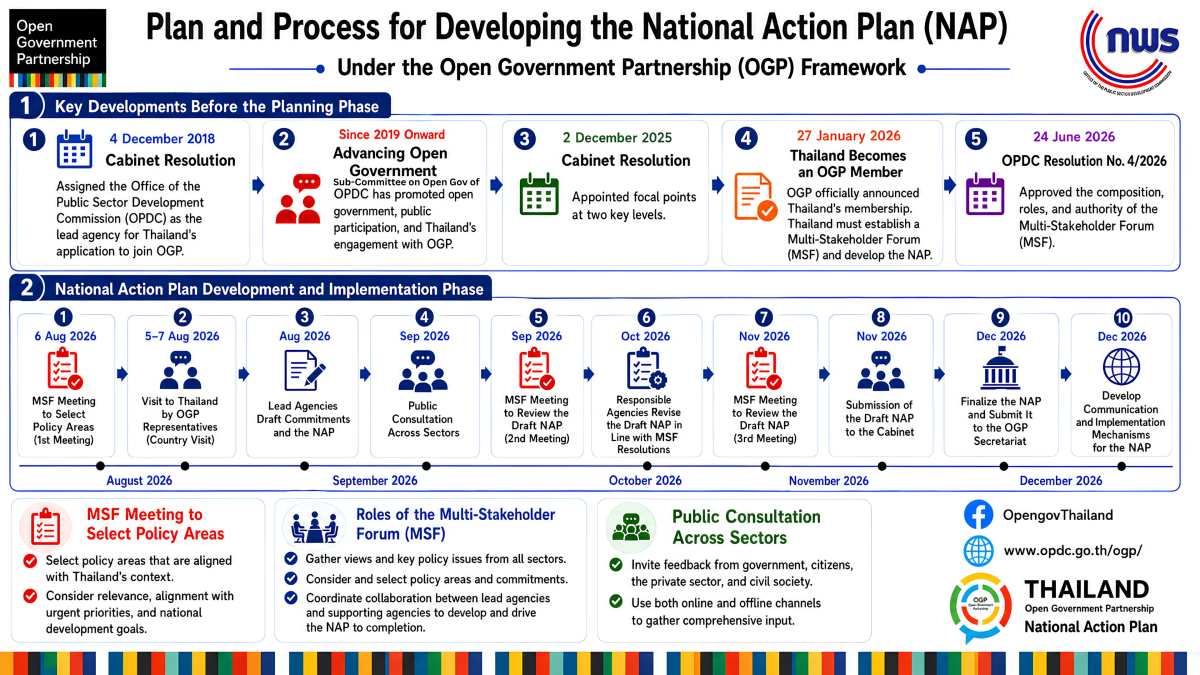
The process of developing a National Action Plan (NAP) begins with gathering opinions from all sectors nationwide through both on-site meetings and online channels. The information, opinions, issues, and suggestions collected are then analyzed, categorized, and prioritized according to their policy areas’ importance. This data is used for the Multi-Stakeholder Forum (MSF) meetings, a crucial mechanism for reviewing policy issues and selecting appropriate proposals for the NAP development.
Following the MSF’s review, Policy Areas and Commitments are determined, representing key policy areas and commitments that Thailand will implement under the OGP framework. These are then developed into detailed NAP plans through meetings with relevant agencies under each project, including government agencies, civil society organizations, and the private sector. The NAP plan is then presented in subsequent phases. This Thai process reflects the principles of open government: Transparency, Public Participation, Accountability, and Technology and Innovation, which are the pillars of OGP.
2. Reasoned Response and Finalization
After receiving opinions and collecting proposals, the next step is to systematically review all opinions, not merely as symbolic listening, but by analyzing proposals, assessing feasibility, ensuring alignment with the OGP framework, and determining their suitability for development under NAP. In this phase, explanations, justifications, and clarifications are provided for all proposals received from various sectors. This allows stakeholders to understand which proposals are adopted, which require adjustment, and which cannot be included. Reasoned Responses are thus an important part of the NAP development process as they enhance transparency and credibility.
Once the MSF reviews and selects the policy areas and commitments to include in the plan, the process moves to developing a complete NAP. This involves defining the plan’s substance, implementation approaches, relevant agencies, and implementation timelines. The plan is then presented to the OPDC, MSF, and the Cabinet, and subsequently submitted to the OGP. This step marks the transformation of proposals from various sectors into an official action plan that can be implemented in practice.
3. Planning and Outreach
In the initial phase of NAP development, consultation input is planned, and target areas are identified nationwide. This ensures that information can be gathered from diverse stakeholders at both central and local administration levels. Fieldwork and online consultation channels increase opportunities for the public and various organizations to express their views broadly, particularly on issues related to local problems or public matters that directly affect citizens. Online channels also improve participation coverage, especially for remote communities, those with time constraints, or those unable to attend local meetings. Additionally, the NAP development process reflects the role of local supporting agencies and inter-agency coordination mechanisms in organizing meetings, collecting proposals, and forwarding information to the central process. Outreach, reaching out to stakeholders, is therefore the heart of this plan, as it ensures comprehensive and inclusive NAP development that is not limited to policymakers alone. As the process moves into its middle phase, input from consultations is analyzed and compiled into issues for MSF discussions. These are then developed into draft plans and enter the review stage between August and September 2026.