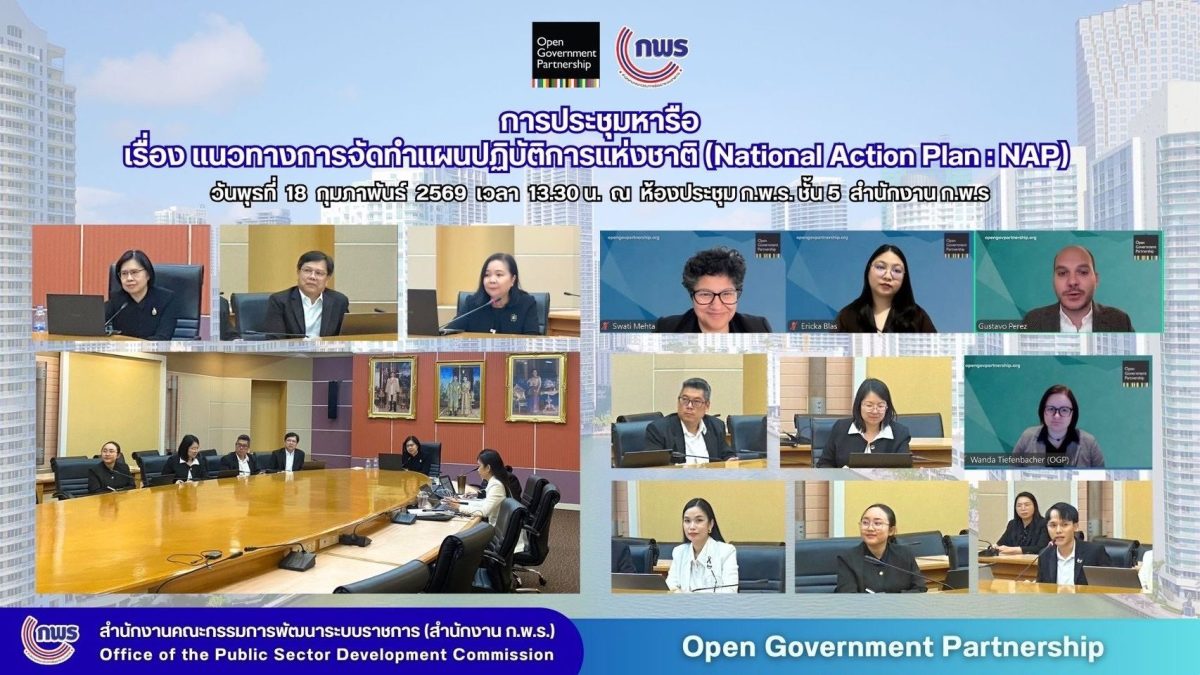
 On Wednesday, 18 February 2026, the Secretary-General of OPDC, together with Mrs. Areepan Charoensuk, Senior Advisor to OPDC, Mr. Thanasak Mangkarothai, Deputy Secretary-General of OPDC, Mr. Sumit Kesawapitak, Director of the Division of Regional and Local Administration Development, and officials from the Division, held a consultation meeting with Ms. Swati Mehta, Asia-Pacific Regional Lead; Ms. Ericka Blas, Asia-Pacific Regional Officer; Ms. Kamonwan Panyasavanamitr, Policy and Partnership Advisor; Mr. Gustavo Perez Ara, Head of Membership Services; and Ms. Wanda Tiefenbacher, Project Coordinator, Membership Services, from the Open Government Partnership (OGP).
The meeting aimed to discuss approaches for developing Thailand’s National Action Plan (NAP). Representatives from the public sector, private sector, and civil society also participated, including the Department of Marine and Coastal Resources, the Department of Climate Change and Environment, the Thailand Institute of Justice (TIJ), Bangkok Metropolitan Administration, 30×30 Thailand Coalition, HAND Social Enterprise, and the Anti-Corruption Organization of Thailand (ACT).
Key points are summarized as follows:
Significance of OGP membership
Participation in OGP presents a key opportunity for Thailand to strengthen good governance through a global framework that emphasizes transparency, participation, and accountability. OGP is a unique model that enables equal collaboration between government and civil society in designing and implementing reforms.
Key features of the OGP model
OGP is characterized by four core elements:
 Partnership on equal terms between government and civil society
 An action-driven framework with in-built accountability
 A country-led approach tailored to the national context
 A global community of reformers
Thailand is part of a network of over 70 countries and more than 150 local governments worldwide, providing a platform for knowledge exchange and international support.
Core of OGP: National Action Plan (NAP)
The NAP is developed through a co-creation process, where government and civil society jointly identify issues, set priorities, and develop clear, actionable commitments that deliver tangible results, based on shared decision-making and ownership.
Participation and Co-Creation Standards (5 key principles)
1. Establishing a Multi-Stakeholder Forum (MSF)
2. Ensuring transparency and timely information disclosure
3. Promoting inclusive and broad participation
5. Enabling participation in monitoring and evaluation
Key implementation mechanisms: MSF and Point of Contact (POC)
 The Multi-Stakeholder Forum (MSF) is a central mechanism for sustained collaboration between government and civil society. It is responsible for setting strategies, planning, communication, and overseeing the NAP process, with clearly defined stakeholder composition, rules, and timelines.
Experiences from member countries show that MSF structures can vary:
 Côte d’Ivoire adopts a multi-tier structure separating policy and technical levels
Kenya establishes a high-level committee alongside thematic working groups
Chile uses an “Open State Forum” integrating multiple state institutions
Ghana forms a steering committee with broad stakeholder representation
Despite different models, the key principle is to create a continuous, transparent, and well-defined collaboration platform.
The Point of Contact (POC) plays a crucial role in coordinating and managing the overall OGP process, ensuring alignment across agencies and maintaining continuity and transparency.
Accountability and transparency: Independent Reporting Mechanism (IRM)
OGP’s IRM provides evidence-based assessments of the quality of collaboration, compliance with minimum requirements, ambition of commitments, and results achieved. The IRM collects data from multiple sources, drafts reports, allows for government fact-checking, and then publishes findings to enhance transparency and credibility.
 Next Steps: OPDC will disseminate knowledge to build understanding of MSF establishment and continue advancing the co-creation process to ensure inclusive participation in developing Thailand’s NAP.