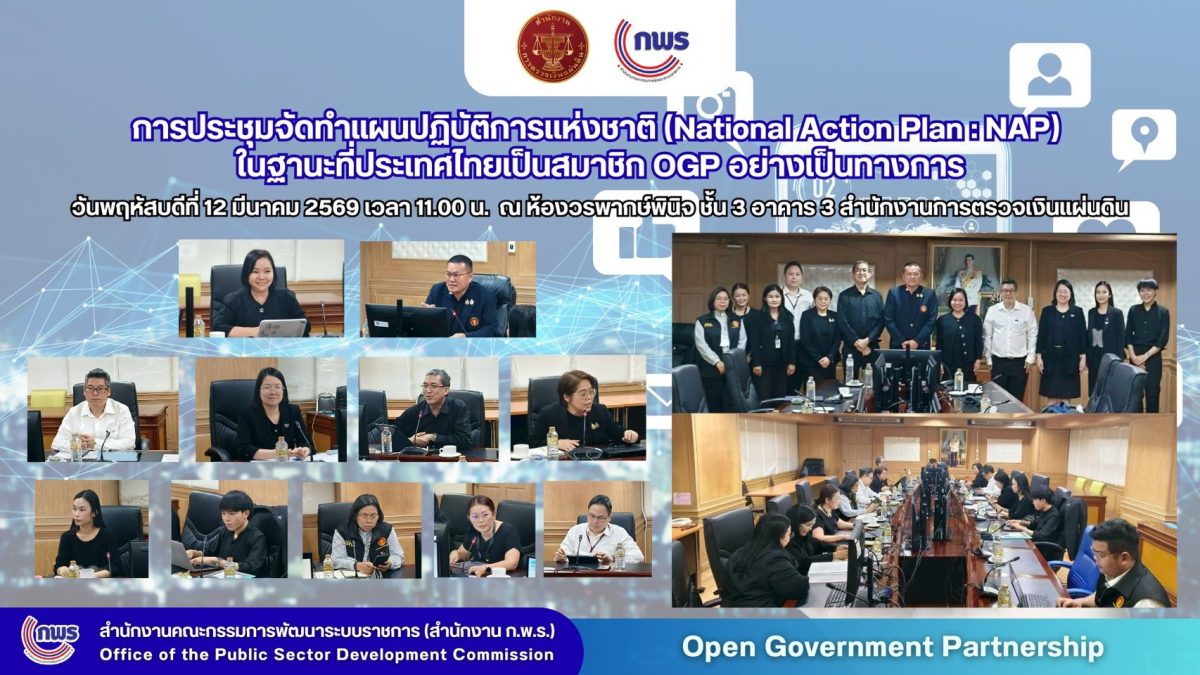
On 12 March 2026, Mrs. Areepan Charoensuk, Senior Advisor to OPDC, and Mr. Sumit Kesawapitak, Director of the Division of Regional and Local Administration Development, together with OPDC officials, held a consultation meeting with the State Audit Office of Thailand to explore approaches for incorporating initiatives into Thailand’s National Action Plan (NAP) under the Open Government Partnership (OGP). The meeting included discussions with Mr. Suttipong Boonnithi, Deputy Auditor General, Mr. Pongthorn Chuechawalit, Director of the Digital and Audit Innovation Center, and officials from the State Audit Office (SAO). Key points are summarized as follows:
1. State Audit Office of Thailand (SAO) Initiatives
– SAO is advancing initiatives to enhance transparency and foster multi-stakeholder participation in safeguarding public funds and state assets.
– SAO is driving initiatives to promote transparency and multi-stakeholder participation by aligning its operations with the national anti-corruption strategy and the Sustainable Development Goals (SDGs). The core concept shifts auditing from a single-agency function to a collective societal effort through collaboration among the public sector, citizens, private sector, and independent organizations to monitor, report clues, and protect national interests.
2. Public Finance Protection Network Development Plan
– The initiative is structured in three phases:
Phase 1: Building knowledge and awareness on safeguarding public funds
Phase 2: Developing innovation and tools to support participation
Phase 3: Evaluating project outcomes
In 2026, SAO will focus on capacity-building and awareness-raising among public officials and citizens under the concept of “Know, Be Aware, and Co-Protect.”
By 2027, two key networks—public sector and citizen networks—are expected to be established to work together concretely and connect through digital platforms or applications.
3. Promoting e-Participation and Digital Whistleblowing Channels
– Public participation is promoted at three levels: awareness, understanding, and two-way communication, supported by e-Participation systems and reporting channels via the LINE application for greater convenience in communicating with the public sector.
– Whistleblowers may remain anonymous, with SAO officials conducting initial screening before forwarding cases to relevant agencies.
– The initiative also encourages citizens to help monitor the efficient and worthwhile use of state assets.
4. Disclosure of Audit Results for Public Use
– SAO plans to enhance the accessibility of audit findings by presenting annual audit reports in infographic formats for better public understanding and legal compliance.
– Disclosure will be provided in two formats: general public communication to provide an overview of audits, and structured data containing statistics that citizens can utilize for further analysis or development.
Next Step: OPDC, in collaboration with SAO, will develop the NAP under the themes of digital governance and public participation to advance Open Government in line with OGP standards.