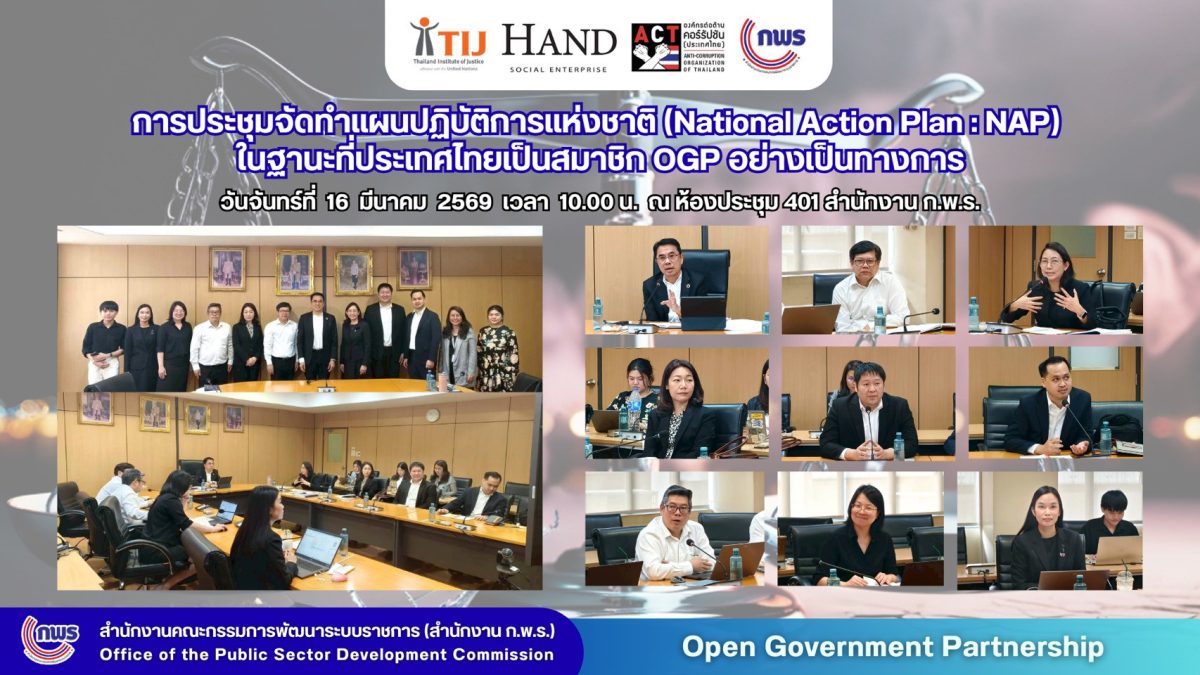
On 16 March 2026, Mr. Buntoon Srethasirote, Chair of the Subcommittee on Promoting Open Government and Public Participation, Mr. Thanasak Mangkarothai, Deputy Secretary-General of OPDC, Mr. Sumit Kesawapitak, Director of the Division of Regional and Local Administration Development, and Ms. Kanokporn Sriwitaya, Public Sector Development Expert, together with OPDC officials, held a consultation with the Thailand Institute of Justice (Public Organization) (TIJ) to explore approaches for incorporating initiatives into Thailand’s National Action Plan (NAP) under the Open Government Partnership (OGP). The meeting included discussions with Dr. Anuwann Wongpichate, Deputy Executive Director of the Thailand Institute of Justice (Public Organization), Dr. Apamas Chanmekha, Director of the Office of Justice Innovation, Mr. Kittidej Chantangkul, Director of the Anti-Corruption Organization of Thailand (ACT), Mr. Suphorrat Bosuwan, Managing Director of HAND Social Enterprise, and TIJ officials. Key points from the discussions are summarized as follows:
1. TIJ Initiatives
– TIJ emphasized that key OGP priorities are closely aligned with OECD frameworks. Strengthening coordination between these frameworks is essential to reducing duplication and enhancing policy effectiveness. Two major policy areas were highlighted:
1) Anti-Corruption
– National Rule of Law Policy Framework Development: This initiative aims to support national reform and promote transparency through open data in public administration. Based on the Open Data Charter, Thailand has identified 25 key datasets for public disclosure—such as public procurement, government budgets, and asset declarations of public officials. When made available in interoperable and analyzable formats, these datasets can significantly enhance transparency, prevent corruption, and enable early detection of irregularities. Regulatory reform is also emphasized to reduce discretionary power and opportunities for bribery.
– Integrity Ecosystem Approach: Anti-corruption efforts should go beyond legal enforcement or suppression to encompass a comprehensive ecosystem involving market mechanisms, institutional frameworks, and societal values. The model consists of three tiers:
Tier 1: Intervening in market dynamics to close corruption gaps
Tier 2: Strengthening political commitment and institutional frameworks
Tier 3: Building integrity culture and values through education and public participation
This approach aims to reduce incentives and opportunities for corruption while increasing the cost of misconduct across both public and private sectors, supported by risk management tools and international indicators such as the Corruption Perceptions Index (CPI) and the Rule of Law Index to monitor performance continuously.
2) Justice
– Strengthening the Rule of Law and Public Sector Governance in line with OECD and International Standards: * This initiative aims to enhance Thailand’s justice system and rule of law through collaboration between TIJ and OECD. The focus includes studying and analyzing the Thai justice system regarding access to justice, good governance, and criminal justice processes, leading to the development of strategic plans and policy recommendations for reform to ensure efficiency, transparency, and a citizen-centric approach.
2. People-Centered Justice Concept
– TIJ also promotes a People-Centered Justice approach, utilizing tools such as the Justice Needs Survey and international indicators like the Rule of Law Index by the World Justice Project (WJP) to inform policy development and innovation. The initiative encourages collaboration among government, academia, and civil society to improve the long-term effectiveness and transparency of the justice system.
Next Step: OPDC, in collaboration with TIJ, will further develop the NAP under the policy areas of Anti-Corruption and Justice to advance Open Government in line with OGP standards.